
The Quiet Frontline

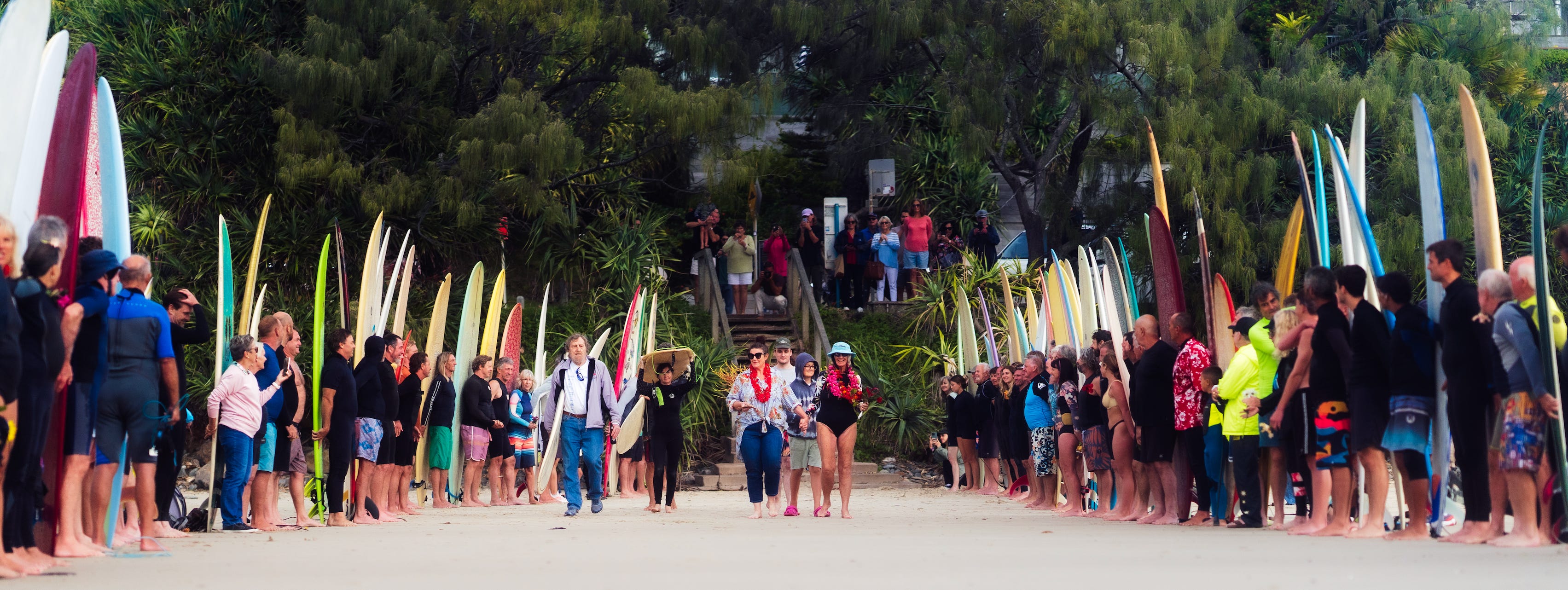
I grew up on the beach. My dad was a phenomenal waterman, surfing since he was eight years old, the kind of man who could read the ocean the way other people read a room. The photo above is from the celebration of his life on the very beach in Byron Bay, Australia that he taught me how to spot a storm coming, to find the rips, to respect what the water was doing beneath the surface even when the surface looked calm. But it was tidal surges that fascinated me most. I’d ask him about them over and over. And he’d say the same thing every time, “the ocean doesn’t need to announce itself pumpkin”. It just keeps coming, slow and certain, and by the time you feel it curling around your ankles, it has already decided. It knows exactly where it’s going. It just hasn’t told you yet.
That’s how this comes in. Not crashing. Surging. Incrementally, patiently, until the ground beneath you has quietly disappeared and you’re fighting to stay upright in something you didn’t see building and drowning becomes a real possibility for those who weren’t watching, weren’t warned, weren’t ready.
That surge is a thumb moving across glass in a dark bedroom. It looks like all of us because we have all been here, are still here, more nights than we’d care to admit. Our faces lit from below by a feed that does not sleep, does not tire, does not pause to ask who is on the other end of it. Who is watching. Who is being watched. Whether the machine that built this moment gave any thought at all to whether we’d make it back to shore.
Real names. Real deaths. A senior intelligence figure killed in a strike not a codename, not a designation, a person and the news arriving in the same feed, between the same reels, at the same pace as everything else. Threats issued in public, stripped of diplomacy and sharpened into spectacle. Deadlines set for the Strait of Hormuz like a countdown clock someone thought to post for engagement. Promises of infrastructure wiped from the earth delivered in language that feels less like policy and more like performance as if the audience is the point.
Thousands already dead across Iran and Lebanon. Attacks stretching across Iran, Israel, the UAE, Saudi Arabia. Retaliation already forming in the wings, patient as a tidal surge. Countries now arresting people for sharing footage of missiles overhead.
And online, the world is taking sides. Americans choosing Iran. Others choosing Israel. Others choosing silence and being punished for that too. The entire spectrum collapsing into a single volatile stream where allegiance shifts by the hour, certainty evaporates before you can hold it, and nobody, not a single one of us scrolling in the dark, can tell anymore where information ends and manipulation begins.
It arrives the same way. In fragments. In a scroll. Between a recipe and a reel and a memory from three years ago that the algorithm decided you needed to see right now. Between everything else.
I live between two continents right now, trying to make decisions about movement in a moment where nothing feels stable and every option has a hidden cost…..literaly. I usually fly through Dubai, and that has become my familiar hinge between worlds, the place where East and West briefly meet in the same terminal and now even that is not an option. This time I am flying Rome/London/Singapore/Perth/Sydney knowing that when I leave home here, I don’t know if or when I get back from home there and vice versa. The geography that once felt like freedom now feels like a question I don’t have an answer to.
Two of my closest friends are deep inside it.
One in Dubai, watching the sky and navigating the strange, surreal normality that sits beneath the tension. She still takes her dog to the beach. The view of the city from her home is still glittering. There seems to be an unspoken agreement to keep moving, as if stillness might make it real and she holds it the way everyone there seems to be holding it. Carefully. Quietly. Together.
The other is working in Baghdad. He spent years in defence, knows the Middle East the way most people know their own street its moods, its rhythms, its particular silences that mean something is shifting. He loves it there, genuinely, in that deep way that only comes from choosing a place rather than simply being born to it. And that love is precisely why I get nervous. Because he won’t leave until he absolutely has to. Maybe not even then.
And then there is my partner, a landscape architect who has worked across the whole of the Middle East for years. He talks about the way his designs are built not just for beauty but for survival. Shade calculations, airflow, the precise and careful science of cooling human beings in the desert. He is physically present and yet part of him is always oriented east. Lately the mathematics he is quietly running are not about design. They are about what happens if an energy grid gets struck. What happens to a desalination plant when it becomes a target. What an oil slick in the Strait of Hormuz actually means for millions of people who depend on infrastructure that most of the world has never had to think about. He explains it to me carefully, in the way people explain things when they have seen the actual place, know the actual people, understand that behind every strategic asset is a neighbourhood, a school, a family doing exactly what we are doing. If the wrong things are hit, he says, simply, quietly, we will be looking at a humanitarian crisis beyond anything the modern world has witnessed. He doesn’t say things like that for effect.
And then there is our friends Iranian girlfriend, a brilliant young architect who has just passed her exams to practise here in Italy. Exams you can only do in Italian. She is living outside her country and right now navigating something that I find almost unbearable to imagine. Iran has shut down the internet. Not slowed it. Not filtered it. Shut it down. She has small windows, unpredictable and brief, to reach her family. She takes them when they come, whatever time it is, wherever she is. The wider Iranian diaspora is operating in a way Australians would call the “bush telegraph” news passed person to person, community to community, fragments assembled into something resembling a picture, the whole network straining toward home. What she knows, she knows because someone told someone who told someone who managed to get a signal. What she doesn’t know sits with her the rest of the time, which is most of the time.
They are not living in the feed’s version of this. They are living in the actual version, slower, more textured, more human, and infinitely more terrifying in the ways that don’t translate to a headline.
Last year, a small YouTube channel called Akhbar Enfejari Explosive News was barely noticeable. Influencer-style political commentary, AI-generated clips, a few hundred views on a good day. And then, almost overnight, it found its formula.
It is now producing AI-generated propaganda about the US-Iran conflict in the style of Lego animations. World leaders turned into caricatures. Missile strikes rendered in plastic, primary colours, the visual language of a child’s playroom. Lego missiles raining down on cities set to rap soundtracks. A Lego White House in flames. Leaders mocked, humiliated, killed all of it blocky and bright and deeply, quietly wrong in a way that took a moment to locate. And what followed was not fringe virality. It was millions of views. Western audiences sharing and commenting. Iranian state-affiliated outlets amplifying it. Articles in the New Yorker and BBC. Russian media boosting it. Protest movements repurposing it for their own ends. Real geopolitical violence, translated into something that looked like a children’s game but carried the full emotional charge of propaganda.What makes it work is not just the content. It’s the timing, and the ecosystem it enters.
These videos emerged during active military escalation, produced at speed using AI tools that allow a small, anonymous team to generate high-impact visuals within hours. Whether or not the creators are formally tied to the Iranian regime almost becomes secondary to how effectively the content operates inside a system already primed to receive it. Researchers have a name for this now slopaganda. The fusion of generative AI and propaganda. Cheap to produce, endlessly adaptable, designed to meet audiences exactly where they already are. And it doesn’t exist in isolation the Trump administration’s own fluency in meme culture, stylised strike footage, internet-native provocation, has helped normalise this visual language of war until truth competes not on accuracy but on appeal.
A brightly coloured clip where blocky toy soldiers reenact missile strikes over a soundtrack that doesn’t match the weight of what it’s depicting. Real interception footage over Dubai stitched seamlessly with Call of Duty gameplay, edited so cleanly it takes a second look, sometimes a third, to find the seam between what happened and what was rendered. And then language coming straight from the top. Threats of “Power Plant Day” and “Bridge Day” delivered in expletive-laced bursts on a social media platform, reading less like statecraft and more like something engineered specifically to land, to provoke, to spread.
A conflict that is deeply affecting everything and everyone turned into content.I just sat there for a moment, honestly. Staring at it.
I didn’t feel rage, not right then (but as you can probably tell by my writing, I am feeling it now). It was something quieter. Heavier. The kind of feeling that settles in your body when something confirms what you didn’t want to admit was already true. Like — oh. So this is what we’re doing now. This is where we are. An expletive for a punchline, built from the oldest human violence and the newest human technology, wrapped in bright colours and delivered straight to your feed like it always belonged there between the recipe, the reel, and the thing that made you laugh ten minutes ago.
I was thirteen years old at the most dangerous peak of the cold war. When the world came far to close to nuclear war. Even then, even as a kid, I understood that information was already a weapon. It was just a slower one in 1983. Carefully shaped, tightly controlled, broadcast with intention across borders by people in actual rooms making deliberate decisions about what the world should believe. Propaganda had a process. It had authors. It had a chain of command. What we are looking at now is not a new strategy. It is the same instinct to control the story before the other side does, except it has been digitised, accelerated, and handed to systems that no longer requires control in the traditional sense. There is no room. No chain of command. No author you can find and name and hold responsible for what lands on your screen at eleven o’clock at night.
NATO’s own researchers have given it a name. Memetic warfare. A fight not over land, at least not first but over narrative. Over perception. Over who gets to define what is real before anyone has the time or the tools to verify it. The Lego situation is not separate from the war. In this framework, it is part of it. Every share, every laugh, every moment of genuine confusion about what is true and what is not, that is the battlefield now. That is the point. We are all already in it. Most of us just don’t know we enlisted.
So what does that do to a thirteen year old in 2026. Because that child is inside the same stream. The exact same one that I am. Except they arrived without context, without the slow accumulation of years that teaches you how to hold information at a slight distance before you let it in. They don’t have that buffer. Nobody gave it to them and the feed doesn’t care that they don’t have it.
So they sit with missile strikes beside dance trends. A soldier’s final moments cut to music and served with the same interface as a makeup tutorial. Propaganda wearing the face of entertainment and often performing better than entertainment because it is so much easier to consume. Outrage is everywhere. Simplicity travels. Lego is more watchable than a briefing, and the algorithm knows this with a certainty that no journalist, no teacher, no parent can match.
Sixty-five percent of young people now rely on social media as their primary source of news. Not as one source. The primary one. And most of them are online not occasionally, not in concentrated bursts, but constantly their feed running in the background of homework, of dinner, of the last twenty minutes before sleep when the brain is at its most open and its least defended. Children are the canary in this particular coal mine. They always have been. We have always known what a society truly values, and what it is willing to sacrifice, by watching what it does and doesn’t protect its children from. The canary doesn’t choose to go down the mine. It is carried there by people who need to know if the air is safe, and who have decided, on some level, that the canary’s distress is an acceptable price for that information.
Our children are showing us the distress. The anxiety epidemics. The fractured attention. The inability to sit with silence or uncertainty or boredom in those ordinary, necessary, deeply human states that a relentless feed has made feel unbearable. The radicalisation happening not in dark corners of the internet but in plain sight, one recommended video at a time. They are telling us, clearly and continuously, that something in the air down here is wrong.
We keep sending them back in.
War arrives to them not as tragedy but as a genre. Fast. Visual. Sometimes ironic. A Lego animation mocking a geopolitical enemy doesn’t read as propaganda to a thirteen year old in 2026. It reads as content. Just another thing that appeared, held their attention for the length of a song, and disappeared before the feeling it left behind could be named or questioned.
That is how conditioning happens. Not in a single moment but in a thousand small ones. The extraordinary becomes ordinary. The unacceptable becomes familiar. Violence fades into background noise not because children are cruel, they are achingly not, but because the volume has been rising so gradually, for so long, that they have simply adjusted. The way the canary stops singing.
Every pause, every replay, every share feeds a system designed to keep attention locked. We have already seen what that optimisation does. The system does not hesitate. It learns and it amplifies. In conflict, that amplification doesn’t pause for accuracy or humanity or nuance. It favours the most extreme, emotional, divisive material available because that material holds attention longest, and attention is the only currency that matters. A humanitarian briefing does not perform as well as AI slopaganda and so the feed buries one and surfaces the other, over and over, millions of times a day, until the version of the world that most people carry around inside them has been quietly, efficiently shaped by what the algorithm decided was worth amplifying. Not what was true. What stuck.
This is not a future problem. It is already here.
The bedroom at night is no longer a place of retreat. It is a frontline. Global conflict arriving without explanation, without mediation, without anyone there to sit beside a child who has their phone in their room and say — here is what this is, here is what it isn’t, here is how to sit with it and because most parents are inside the same system, just as overwhelmed, just as unequipped, trying to make sense of it themselves at the other end of the house. There is a quiet grief in that. The grief of distortion. The slow reshaping of reality until everything feels equally uncertain, equally distant, equally unreal.
War is no longer confined to geography. It is everywhere now. Including the quietest room in the house, where a child lies awake, screen glowing, absorbing a version of the world that no one has explained to them and no one is truly controlling.
That is where another frighteningly real battle is being fought. The battle for minds that are still forming. Over what this generation will come to accept as normal.
We used to worry about what children might stumble across online. Now it is what is being deliberately placed in front of them.
I think about that future. I think about it a lot. A generation whose instinct for truth was calibrated inside a system that rewarded virality over accuracy. Whose emotional response to violence was gradually, quietly, patiently normalised before they ever had the chance to decide for themselves what they believed. What kind of voters will they become? What kind of leaders? What kind of parents? What will they tolerate that we cannot imagine tolerating? What will feel ordinary to them that should never?
We are not just shaping childhoods here when we hand them a phone that can connect to the internet thinking they need it for safety. We are shaping the people who will inherit whatever world we are too busy scrolling to protect.